
Introduction: More Than Just a Game
The History of Cricket
Cricket is not merely a sport; it is a sprawling, centuries-old narrative etched into the social, cultural, and political fabric of several nations. Often described as the “gentleman’s game,” its unique rituals, arcane terminology (like ‘googly,’ ‘silly mid-off,’ and ‘leg before wicket’), and leisurely pace have long baffled outsiders. Yet, to its devotees, it offers a compelling blend of athleticism, strategy, and enduring tradition. From its humble origins as a rustic pastime in medieval England to its current status as a global spectacle with vast commercial power, the history of cricket is a captivating journey across continents and centuries, reflecting the rise and fall of empires, the evolution of social class, and the complex relationship between the colonizer and the colonized. Tracing its lineage reveals how a simple stick-and-ball game became a powerful cultural institution and a unifying (or sometimes divisive) force for billions.
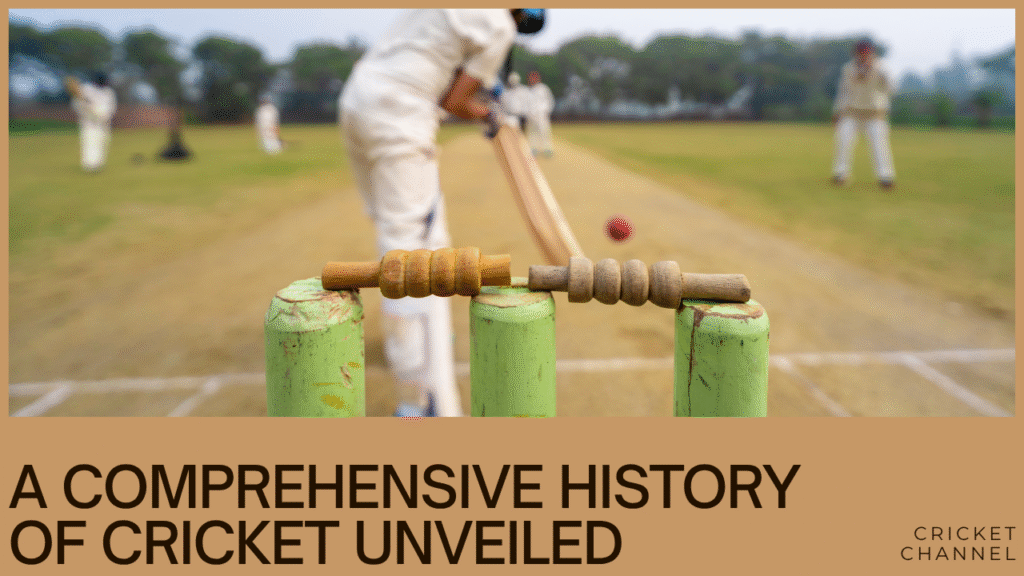
I. Genesis in the Shires: Cricket’s Medieval Roots (c. 13th–17th Centuries)
The precise birth date of cricket is lost to history, but the general consensus places its earliest identifiable form in the south-east of England, particularly in the wooded and weald areas of Kent and Sussex. Etymologically, the name “cricket” itself offers a clue, potentially deriving from an Old English word like “cryce” (a crutch or staff) or the Middle Dutch “kricke” (a stick or staff). It’s plausible that the game evolved from several earlier bat-and-ball folk traditions.
The Earliest Documented Mentions
The most commonly cited and earliest documentary evidence comes from a 1598 court case in Guildford, Surrey. The court records mention a parcel of land being historically used for “crickett” as far back as 1550. This reference confirms that the game was already established in Tudor England, played perhaps by schoolboys or labourers on common land.
Another significant early mention dates to 1611, where two young men in Sussex were prosecuted for playing cricket on a Sunday instead of attending church—a sign that the game was popular enough to compete with religious observance. This period suggests cricket was primarily a village sport, played with rudimentary equipment: a bat shaped like a hockey stick or a curved club (ideal for striking a ball rolled along the ground), wickets that may have been a stool or gate (stulp), and a hard ball, possibly of wood or tightly wound cloth. The format was likely “single wicket”—where there was only one wicket and one batsman defending it, sometimes with two players fielding.
The Commonwealth and the Rise of Patronage
The turbulent English Civil War (1642–1651) and the subsequent Puritan Commonwealth under Oliver Cromwell placed restrictions on many forms of popular entertainment, including sports and gambling. While professional games may have paused, cricket likely survived in private schools and aristocratic estates.
The Restoration of the Monarchy in 1660 proved to be a pivotal moment. The lifting of the Puritan ban saw a massive resurgence in sports, and cricket quickly became a favourite of the gentry. This is when the game began its crucial transition from a simple folk game to an organized spectator sport. Wagering played an enormous role; the aristocracy found the game a perfect vehicle for high-stakes betting, and this need for clarity and fairness in betting led directly to the first steps towards codification.
II. Codification and the Georgian Era: The Birth of the Modern Game (c. 18th Century)
- The Rise of Patrons and Clubs: The establishment of the Hambledon Club (the “Cradle of Cricket”) in Hampshire.
- The Evolution of Rules: The shift from the low, two-stump wicket to the three-stump wicket; the invention of the straight bat to counter the development of the pitched delivery (rather than the roll); the introduction of the Leg Before Wicket (LBW) rule (1774).
- The Role of Lord’s and the MCC: The formation of the Marylebone Cricket Club (MCC) in 1787 and their immediate assumption of responsibility for the Laws of Cricket. The establishment of Lord’s as the spiritual home of cricket.
III. Imperial Expansion: Cricket Follows the Flag (c. 19th Century)
- Export to the Colonies: How the British Army, Navy, and colonial administrators introduced cricket to their territories. The game as a tool of cultural assimilation and a symbol of British identity.
- The Dominions: The rapid adoption and indigenization of the game in Australia, South Africa, and New Zealand. The development of strong domestic structures.
- The Subcontinent: The unique story of cricket in India, Pakistan (pre-partition), and Sri Lanka, often played by the local aristocracy and later becoming a mass phenomenon.
- The First International Match: The 1877 match between England and Australia, retroactively deemed the First Test Match. The birth of the Ashes rivalry and the concept of international competition.
IV. The Golden Age and Its Aftermath (1890s–1930s)
- The ‘Golden Age’ (pre-WWI): A focus on high-quality amateur (Gentlemen) and professional (Players) cricket, dominated by figures like W.G. Grace (the game’s first superstar). Emphasis on elegant batting and the concept of the sporting spirit.
- Bodyline: The infamous 1932–33 Ashes tour where England, led by Douglas Jardine, used “leg theory” bowling (fast, short-pitched deliveries aimed at the batsman’s body) to neutralize the extraordinary skill of Don Bradman. The resulting diplomatic incident and rule changes.
- Inter-War Consolidation: The development of the County Championship in England and the Sheffield Shield in Australia.
V. Post-War Era and the Rise of the Global Game (1945–1970s)
- The West Indies Revolution: The emergence of the West Indies as a dominant global force, reflecting a post-colonial assertion of pride and identity. The captivating style of play.
- De-Colonization and Expansion: The full entry of newly independent nations (India, Pakistan, Sri Lanka) into the top tier of Test cricket, challenging the dominance of the ‘Old Guard’ (England and Australia).
- The Drawback of Test Cricket: The criticism that the five-day format was too long, slow, and increasingly susceptible to drawn matches, threatening the sport’s long-term viability in a fast-paced world.
That is an excellent point. To fully appreciate the modern game, it is essential to detail the contrasting formats that define cricket today. The proliferation of these various lengths is the single biggest factor in the sport’s current global commercial appeal.
Here is the expanded section, which you can integrate into the existing outline under the new heading: V. The Three Pillars of Modern Cricket: Test, ODI, and T20.
V. The Three Pillars of Modern Cricket: Test, ODI, and T20
Modern cricket is defined by a dynamic format structure, a tiered system that ensures the game appeals to both the purist seeking endurance and the casual fan demanding instant action. These three major formats—Test, One-Day International (ODI), and Twenty20 (T20)—demand vastly different skill sets, strategies, and psychological approaches, creating distinct competitive ecosystems.
1. Test Cricket: The Ultimate Test of Endurance
Test cricket remains the longest and most revered format, often referred to as the “pinnacle” or the “purest form” of the game.
- Duration and Structure: A Test match is played over a maximum of five days, with each team batting and bowling in two full innings (unless a result is reached sooner). Play is split into three sessions per day, punctuated by traditional breaks for Lunch and Tea.
- The Strategic Depth: The multi-day nature of the format necessitates complex, evolving strategy. Captains must calculate when to declare an innings (forfeit the remaining wickets) to leave enough time to bowl out the opposition. Batters prioritize patience, technique, and defence to build long innings, while bowlers focus on subtle variations in line, length, and spin to induce errors over hours of play. The changing nature of the pitch over five days—often starting benign and becoming worn and unpredictable—adds a layer of tactical intrigue, rewarding the team that can adapt most effectively.
- The Dress Code: Players traditionally wear all-white kits and use a red ball (though a pink ball is used for the modern Day-Night Test matches).
- The Zenith: This format features the world’s most enduring rivalries, such as The Ashes (England vs. Australia), and is now part of a global competition: the ICC World Test Championship (WTC), which crowns a champion every two years.
2. One-Day International (ODI) Cricket: The Mid-Ground
The ODI format serves as the crucial middle ground, balancing the technical skill of Test cricket with the urgency of the modern game. Born in 1971 out of a rained-out Test match and later solidified by the 1975 Cricket World Cup, the ODI proved that cricket could be a single-day event.
- Duration and Structure: An ODI game is a single-day affair lasting approximately 7–8 hours. Each team gets one innings and is limited to bowling 50 overs (300 balls) per side.
- The Strategic Challenge: Strategy centres on run rate management. The batting team must pace their innings, conserving wickets early on while accelerating aggressively in the final overs. Bowlers and captains must employ a variety of field settings and slower-ball variations to restrict scoring. This format introduced coloured clothing, white balls, and day-night matches, creating a more spectator-friendly, vibrant atmosphere.
- The Global Tournament: The ODI format is the foundation for the sport’s most prestigious event: the ICC Cricket World Cup, held every four years, which generates mass viewership and national excitement comparable to the FIFA World Cup.
3. Twenty20 (T20) Cricket: The Commercial Juggernaut
The newest format, T20, was officially launched in England in 2003 and has since revolutionized cricket’s global business model. Designed to be fast, furious, and finished in the space of an evening, T20 is the game’s answer to modern demands for instant gratification.
- Duration and Structure: A match typically lasts around 3.5 hours, with each team batting for a maximum of 20 overs (120 balls).
- The Strategic Intensity: T20 demands non-stop aggression, innovation, and high-stakes risk-taking. Batters employ unorthodox shots like the ‘scoop’ and ‘reverse sweep’ to hit boundaries, while bowlers constantly mix up their pace and trajectory (often bowling wide outside the off-stump or directly at the batter’s feet) to limit runs. The focus shifts from survival to maximizing every single delivery.
- The Franchise Phenomenon: T20’s primary global vehicle is not international tours, but billion-dollar franchise leagues like the Indian Premier League (IPL), the Australian Big Bash League (BBL), and the Caribbean Premier League (CPL). These leagues attract the world’s best talent through professional contracts, fostering an annual, high-octane spectacle that draws massive crowds and broadcast revenue. This format also has its own premier international tournament, the ICC Men’s and Women’s T20 World Cup.
The Future: Shorter Still?
The evolution continues with even shorter, highly regional variations emerging, such as The Hundred (100 balls per innings, used in England) and T10 (10 overs per innings, used in various leagues). These formats reflect the sport’s ongoing drive to compress the action, appealing to audiences with increasingly short attention spans and ensuring cricket remains a flexible and commercially viable sport in the 21st century.
VI. The Limited Overs Revolution and Modern Cricket (1970s–Present)
- The Birth of ODI (One Day International): The introduction of the Prudential World Cup in 1975, providing a faster, more result-oriented international format.
- Kerry Packer and World Series Cricket (WSC): The 1977 ‘rebel’ tournament in Australia, which fundamentally changed the sport by introducing coloured clothing, day-night matches, white balls, helmets, and a professional pay structure for players. This was a critical turning point for cricket’s commercialization.
- The Rise of Twenty20 (T20): The 2003 creation of a hyper-condensed, three-hour format. The subsequent explosion of franchise leagues like the Indian Premier League (IPL), which have reshaped the economic and competitive landscape of the sport, attracting massive global audiences.
- Technology and Global Reach: The introduction of Decision Review System (DRS), stump microphones, and vast broadcast deals, making the game accessible worldwide and intensifying the scrutiny of its participants.
VII. Conclusion: The Unfolding Legacy
Cricket’s story is one of fascinating endurance and adaptation. From the muddy fields of Kent to the sophisticated stadiums of Mumbai, it has survived war, political upheaval, and commercial challenges. Today, the sport operates on a tiered system—the five-day Test match upholding tradition, the ODI balancing strategy and excitement, and the T20 format driving frenetic energy and global commerce. The ‘gentleman’s game’ remains a complex, captivating legacy, constantly evolving while still fiercely protecting the centuries-old laws that govern its play.